> ## Documentation Index
> Fetch the complete documentation index at: https://docs.tulipai.app/llms.txt
> Use this file to discover all available pages before exploring further.
# Tulip
> Open model credit markets and permissionless inference on Robinhood Chain.
 # Open model credit markets
In version 1, Tulip gives each pinned Hugging Face model revision one canonical ERC-20 credit, one credit/USDG market, and an open marketplace of independent inference providers.
Market creators launch the credit and its permanent Uniswap v4 pool. Providers compete to serve the exact registered model. Users can trade the credit or deposit it into an inference permit and spend it on model usage.
# Open model credit markets
In version 1, Tulip gives each pinned Hugging Face model revision one canonical ERC-20 credit, one credit/USDG market, and an open marketplace of independent inference providers.
Market creators launch the credit and its permanent Uniswap v4 pool. Providers compete to serve the exact registered model. Users can trade the credit or deposit it into an inference permit and spend it on model usage.
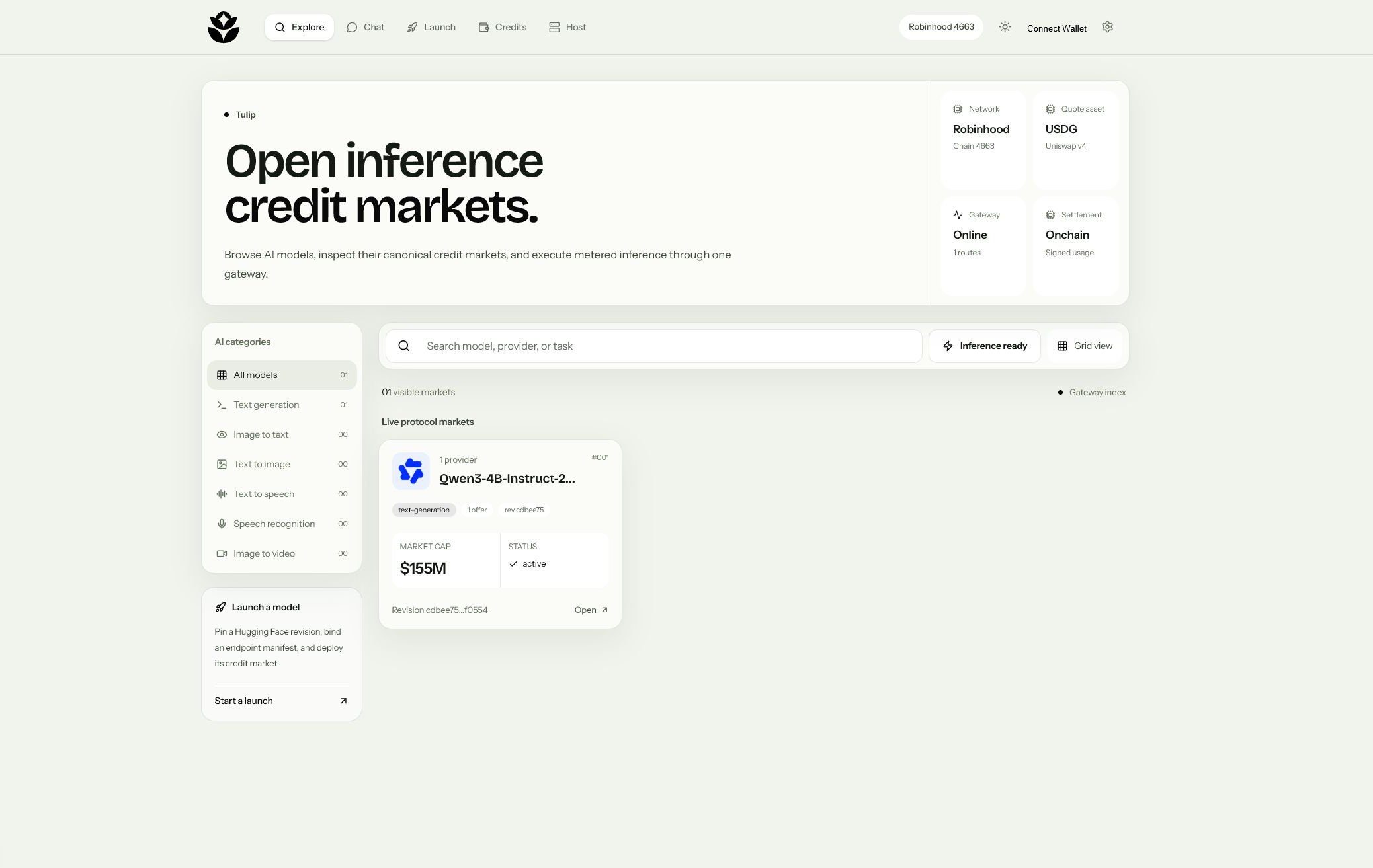 *Browse live model credits, provider availability, and current market status.*
This documentation covers Tulip's production environment on Robinhood Chain. Review every wallet transaction and verify on-chain activity in the [Robinhood Chain explorer](https://robinhoodchain.blockscout.com/) before signing.
Learn how identity, credits, liquidity, providers, and settlement fit together.
Follow the user flow from Robinhood Chain to a paid inference request.
Create the canonical credit and one-sided credit/USDG pool for a pinned model revision.
Register an independently priced Hugging Face Inference Endpoint in version 1.
## One market, many providers
Every model market contains:
* One deterministic v1 `ModelID` for a Hugging Face repository, 40-character commit revision, and task.
* One fixed-supply model credit.
* One canonical Uniswap v4 credit/USDG pool.
* One permanently locked launch position.
* Any number of provider offers with independent tariffs and payout addresses.
The market creator does not need to operate inference hardware. A provider does not need permission from the creator to register an offer.
## Two connected markets
Tulip separates price discovery from inference delivery.
The native Uniswap v4 AMM trades model credits against USDG. Swap execution stays compatible with standard v4 routing and telemetry.
Providers quote input, output, minimum, and wake charges in the model's canonical credit. The gateway selects and meters an eligible offer.
This separation lets a credit develop an open market price while providers compete on inference cost and service quality.
## Demand can arrive before supply
Tulip markets do not require an active inference provider at launch. A model credit can begin trading while the model is still unserved, allowing traders to signal demand before a provider commits capital to hosting it.
Until a provider comes online, the credit remains tradeable but cannot be used for inference. Once service begins, the same market becomes the payment layer for competing providers.
## Where to go next
* Read [How model markets work](/concepts/model-markets) for the full lifecycle.
* Read [Launch curve](/concepts/launch-curve) for the zero-USDG launch design.
* Read [Fees](/protocol/fees) for swap and inference fee distribution.
* Read [Architecture](/protocol/architecture) for trust boundaries and data flow.
*Browse live model credits, provider availability, and current market status.*
This documentation covers Tulip's production environment on Robinhood Chain. Review every wallet transaction and verify on-chain activity in the [Robinhood Chain explorer](https://robinhoodchain.blockscout.com/) before signing.
Learn how identity, credits, liquidity, providers, and settlement fit together.
Follow the user flow from Robinhood Chain to a paid inference request.
Create the canonical credit and one-sided credit/USDG pool for a pinned model revision.
Register an independently priced Hugging Face Inference Endpoint in version 1.
## One market, many providers
Every model market contains:
* One deterministic v1 `ModelID` for a Hugging Face repository, 40-character commit revision, and task.
* One fixed-supply model credit.
* One canonical Uniswap v4 credit/USDG pool.
* One permanently locked launch position.
* Any number of provider offers with independent tariffs and payout addresses.
The market creator does not need to operate inference hardware. A provider does not need permission from the creator to register an offer.
## Two connected markets
Tulip separates price discovery from inference delivery.
The native Uniswap v4 AMM trades model credits against USDG. Swap execution stays compatible with standard v4 routing and telemetry.
Providers quote input, output, minimum, and wake charges in the model's canonical credit. The gateway selects and meters an eligible offer.
This separation lets a credit develop an open market price while providers compete on inference cost and service quality.
## Demand can arrive before supply
Tulip markets do not require an active inference provider at launch. A model credit can begin trading while the model is still unserved, allowing traders to signal demand before a provider commits capital to hosting it.
Until a provider comes online, the credit remains tradeable but cannot be used for inference. Once service begins, the same market becomes the payment layer for competing providers.
## Where to go next
* Read [How model markets work](/concepts/model-markets) for the full lifecycle.
* Read [Launch curve](/concepts/launch-curve) for the zero-USDG launch design.
* Read [Fees](/protocol/fees) for swap and inference fee distribution.
* Read [Architecture](/protocol/architecture) for trust boundaries and data flow.